

Litsea Cubeba Oil, China's Quiet Citral Powerhouse
Litsea cubeba oil is one of the most concentrated natural citral sources on the market, and China controls almost all of it. Distilled from the small pepper-like berries of May Chang, a native Chinese spice tree, the oil carries a bright, sweet citrus profile that flavor and fragrance houses have relied on for decades. Chinese customs data shows total litsea cubeba oil exports of 1,682 tonnes from 2019 to 2023, and China's annual production is estimated at 1,500 to 2,000 tonnes. That scale matters now because the global natural citral market is projected to grow from USD 4.2 billion in 2025 to USD 6.8 billion by 2034, with litsea cubeba accounting for roughly 18.9 percent of natural citral sourcing.
Global natural citral indicator | Value | Source |
Market value 2025 | USD 4.2 billion | Dataintelo Natural Citral Market Report |
Projected value 2034 | USD 6.8 billion | Dataintelo Natural Citral Market Report |
Compound annual growth | 5.6% | Dataintelo Natural Citral Market Report |
Litsea cubeba share of citral sourcing | About 18.9% | Dataintelo Natural Citral Market Report |
Source: Dataintelo, Global Natural Citral Market Outlook 2025-2034; China customs export volume cited in Molecules (Gannan Normal University, 2026).
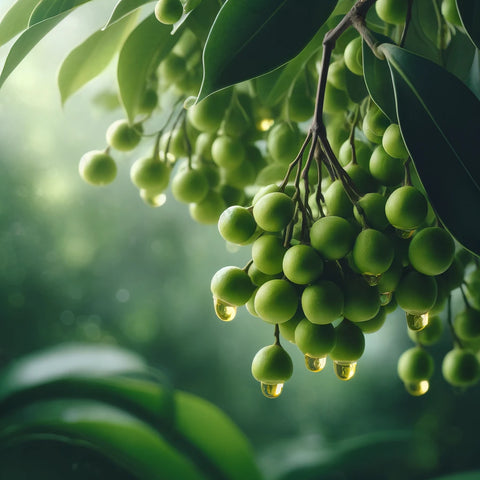
Image: green litsea cubeba fruit clusters on the branch. Source: Bio des Gstrein Patrick
What Litsea Cubeba Oil Actually Is
Buyers new to this ingredient should know that litsea cubeba oil is not a citrus oil, even though it smells like lemon. It comes from Litsea cubeba (Lour.) Pers., a small tree or shrub in the laurel family, Lauraceae, native to China and Southeast Asia. The fruit looks like peppercorns, which is why the plant is also called mountain pepper, and the berries are steam-distilled to produce a pale yellow oil with a fresh, sweet, lemony top note. The defining chemistry is citral, a blend of geranial and neral that can reach 60 to 90 percent of the oil, making litsea cubeba one of the highest natural citral sources in the world. The commercial oil is registered as CAS 68855-99-2 and FEMA 3846, standards that matter when you file specifications for food or fragrance customers.
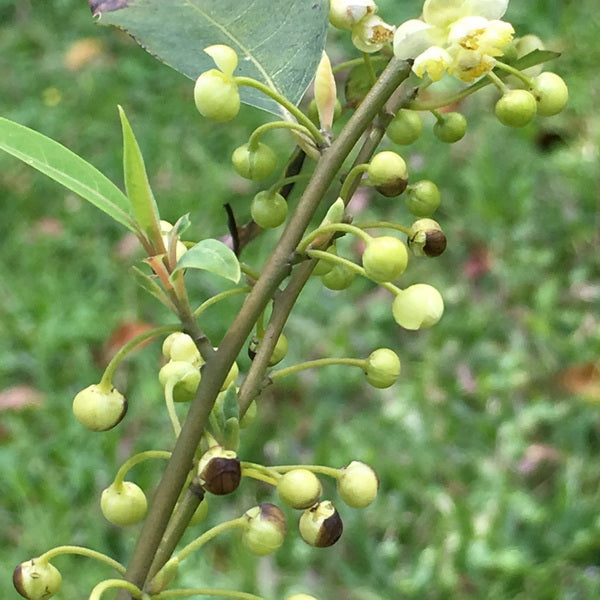
Image: litsea cubeba branch with buds and young fruit. Source: MAAR Fragrances
Production Map and Who Controls Supply
China's south is the center of litsea cubeba production, and the supply base is concentrated enough to plan around. According to a 2023 industry survey compiled by Boyan Research, China produced about 2,840 tonnes of litsea cubeba oil that year, with Yunnan at 52.5 percent, Guizhou at 25.4 percent and Guangxi at 14.4 percent, while Guangdong and other provinces supplied the remainder. Yunnan, Guangxi and Guangdong together hold about 91.6 percent of the national resource base, and Jiangxi's Suichuan county alone accounts for close to half of China's oil processing capacity, according to the Chinese Academy of Forestry's subtropical forestry institute. Guangdong, a newer player, has pushed planted area past 30,000 mu and targets 50,000 mu with a full-chain output value above RMB 1 billion by 2030.
Province (2023) | Litsea cubeba oil output | Share of national output |
Yunnan | About 1,490 tonnes | 52.5% |
Guizhou | About 720 tonnes | 25.4% |
Guangxi | About 410 tonnes | 14.4% |
Other provinces | About 220 tonnes | 7.7% |
Source: Boyan Research survey of provincial agriculture departments, cited in a 2026 China litsea cubeba oil market report (third-party estimate).
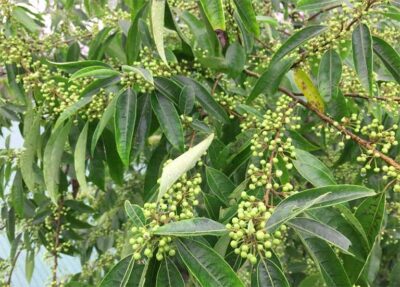
Image: litsea cubeba shrub with green berries. Source: VIPSEN (Vietnam)
Harvest Season and the Move to Planted Supply
Timing drives both quality and price in litsea cubeba. The tree flowers from February to March, and the fruit matures from May through September, turning from green to dark brown as the oil content peaks, so processors concentrate their harvest in a narrow window. Oil yield from fresh fruit runs about 3 to 6 percent by steam distillation, which is why the raw berries, not the leaves, command the market. China has long depended on wild collection, but planted supply is scaling fast: Guangdong's forestry academy is producing over 500,000 tissue-culture seedlings this year, the academy's Xianlinglong variety now covers about 90 percent of planted area in the main Fujian and Guizhou regions, and the first chromosome-level litsea cubeba genome map was completed in 2026 to speed up breeding of high-citral, low-caryophyllene lines.
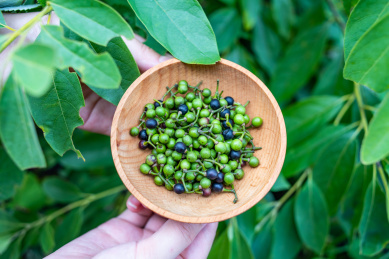
Image: freshly picked litsea cubeba berries in a wooden bowl. Source: Hellorf
Distillation and the Citral Standard
Steam distillation is the industry default for litsea cubeba oil, and China has turned it into a measurable standard. The national standard GB/T 26515.1-2011 for natural litsea cubeba oil sets a citral content of no less than 75 percent, a density of 0.885 to 0.905 g/cm3 and a refractive index of 1.475 to 1.485 at 20 degrees Celsius. Processors have also pushed yields higher: a Yongzhou, Hunan producer that works with Tianjin University reports that redesigned stills lift oil yield by 10 to 17 percent and raise citral content by about 8 percent, with product at roughly 67 percent citral and less than 1.0 percent caryophyllene. For buyers, the practical takeaway is simple, ask for the citral assay and the batch GC-MS, because citral content is the single number that determines both price and downstream performance.
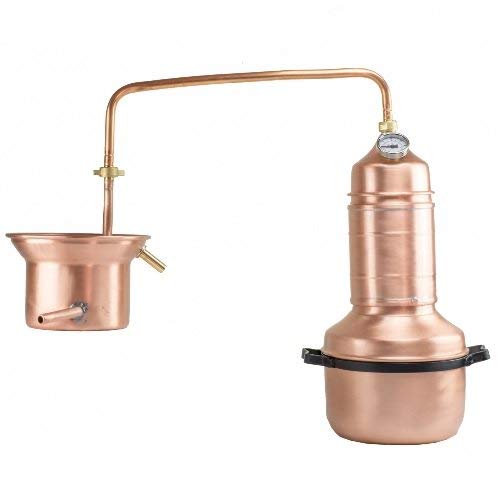
Image: copper alembic distillation equipment. Source: Ofertas (arterameferro)
The Yulin Fuda Hub and Price Discovery
For volume buyers, the market to watch is Yulin in Guangxi. Yulin Fuda International Spice Logistics Port is the world's largest first-tier spice trading hub, carrying more than 160 spice varieties and over 700 merchants, and official accounts report that more than two-thirds of the world's traded spices pass through Yulin, with about 80 percent of China's spice volume flowing through the same channel. In 2025 the market's transaction value reached RMB 33.5 billion, the third straight year above RMB 30 billion. Litsea cubeba oil connects directly to this hub: Guangxi Yulin's Qiangcaotang Natural Spices is one of China's largest litsea cubeba distillers, and Yulin-based traders handle much of the oil that moves from Yunnan, Guizhou and Guangxi origins to coastal ports and export markets.
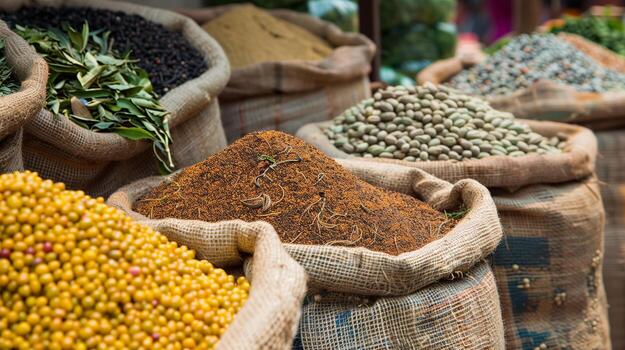
Image: dried spices displayed in burlap sacks at a street market. Source: Vecteezy
Price Benchmarks and the 2025 Market
Price levels for litsea cubeba oil depend mainly on citral content, volume and certification, and the spread is wide enough to justify careful quoting. On export platforms, wholesale listings for pure, natural litsea cubeba oil run from about USD 17 to 30 per kilogram, with MOQs as low as 1 to 2 kilograms for samples and small lots. Domestic bulk channels in China list wholesale litsea cubeba oil from about RMB 106 per kilogram upward, and a 2026 industry report puts the 2025 factory ex-works price at about RMB 68,500 per tonne, roughly USD 9.5 per kilogram, with year-on-year growth of 11.3 percent. An older international reference from the Sri Lanka Export Development Board listed litsea cubeba oil at USD 35 per kilogram, which shows how much premium-grade, certified product can carry.
|
Source: Alibaba.com listings; 1688.com; 2026 citral market report (third-party); Sri Lanka Export Development Board price sheet.
Image: amber essential oil bottles with different closures. Source: Made-in-China.com (Yulang)
Food Applications Driving Volume
In China's kitchens, litsea cubeba oil and the dried berries known as mujiangzi are serious business. The oil is a signature seasoning in Guizhou sour soup fish, pickled vegetables, braised duck and sour hot pot bases, and unlike many aromatherapy oils it is safe for direct food use, which is the core advantage that keeps it in the cooking-oil aisle. Food manufacturers use it as a clean-label natural lemon flavor and as a preservative: research published in the journal Scientia Silvae Sinicae reports that the oil inhibits aflatoxin-producing molds and can protect stored grain and beans. The kernels, after oil extraction, are processed into lauric acid and other medium-chain fatty acids as a coconut oil substitute, so almost nothing in the berry goes to waste.

Image: Guizhou sour soup fish hot pot, a signature litsea cubeba application. Source: Toutiao
Fragrance and Cosmetic Demand
The perfume industry is where litsea cubeba oil earns its premium. Natural citral from litsea cubeba is the standard raw material for synthesizing ionone, the compound that gives violet and many floral top notes their signature scent, which is why high-end perfume houses trace their fresh head notes back to Chinese mountain pepper berries. Beyond fine fragrance, the oil is a workhorse top note in soaps, detergents, candles, air fresheners and personal care, blending well with citrus, floral and woody oils. Its fresh, deodorizing character and clean-label positioning fit the natural cosmetics trend, and the growing shift of major food and fragrance corporations toward natural ingredients by 2030 continues to pull demand upward.
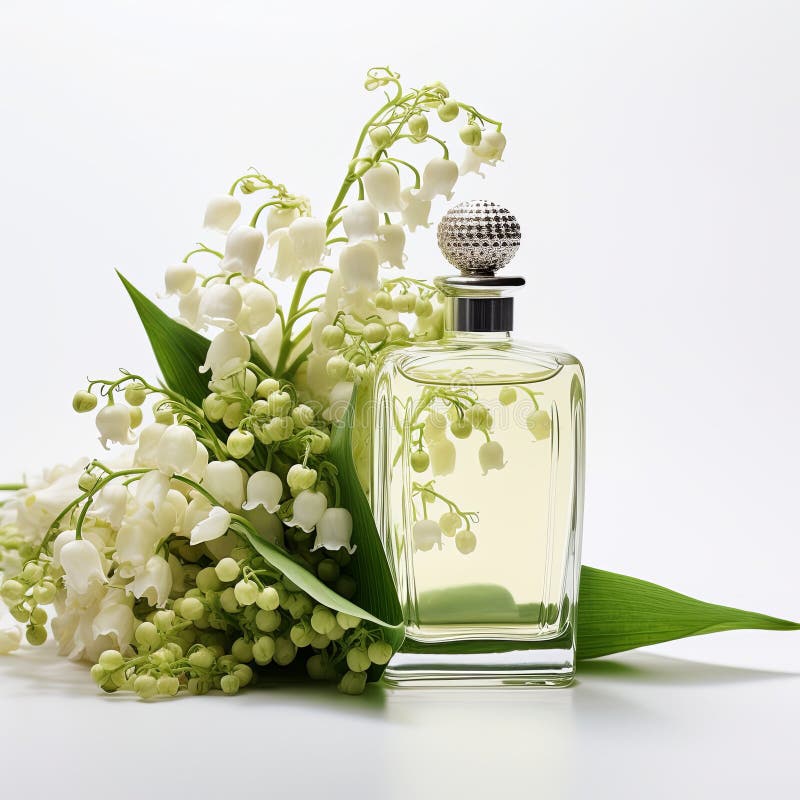
Image: perfume bottle with lily flowers. Source: Dreamstime
Medicinal and Functional Uses
Litsea cubeba oil carries a second demand channel in traditional medicine and functional products that stabilizes year-round orders. Its citral-rich chemistry shows antimicrobial activity, including action against methicillin-resistant Staphylococcus aureus, plus anti-inflammatory and antioxidant properties documented in peer-reviewed studies. In agricultural and storage applications, the oil serves as a natural fumigant and inhibitor against stored-grain pests and crop diseases, offering an alternative to synthetic treatments. In China, product developers have turned the berries and oil into herbal pillows, wellness hammers, medicated dietary packs and oral-care items, while the plant itself is prized for ecological restoration, since it tolerates drought, fixes soil on degraded slopes and is planted widely in Guangdong's green-forest program. For exporters, this breadth of uses means the oil sells into food, fragrance, pharma and agriculture channels from the same drum.
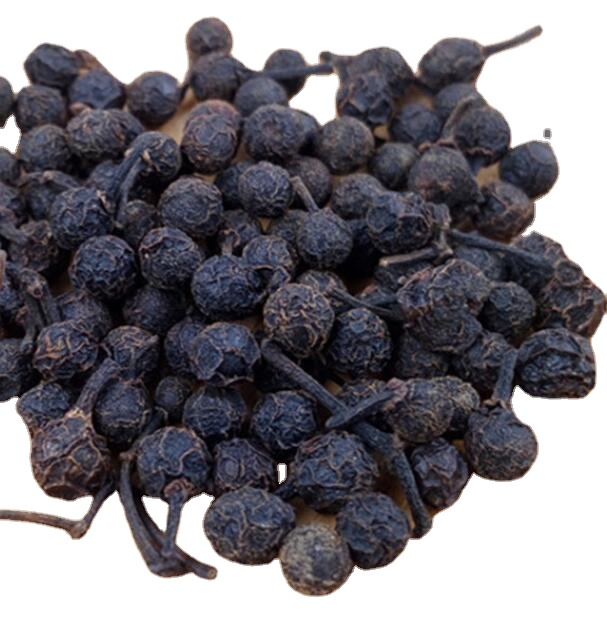
Image: dried litsea cubeba berries, herbal presentation. Source: Alibaba.com
Why Importers Choose spicesmfr
spicesmfr sources litsea cubeba oil from the market where its prices are actually made. We operate at the Yulin Fuda hub, the channel through which more than two-thirds of the world's traded spices pass, with direct buying links to the main origins in Yunnan, Guizhou and Guangxi and to the distillation clusters of Jiangxi. We supply steam-distilled litsea cubeba oil in standard grades of 67 percent and 75 percent citral content, plus higher-purity natural citral for formulators, packed in 25 kilogram pails and 180 kilogram drums with batch-specific CoA and GC-MS reports. Because we sit inside the hub rather than outside it, our quotes track the real market, and our quality control covers citral assay, density, refractive index and residual solvent before shipment. For flavor houses, cosmetic ingredient buyers and food manufacturers, that means consistent oil and paperwork that clears customs.
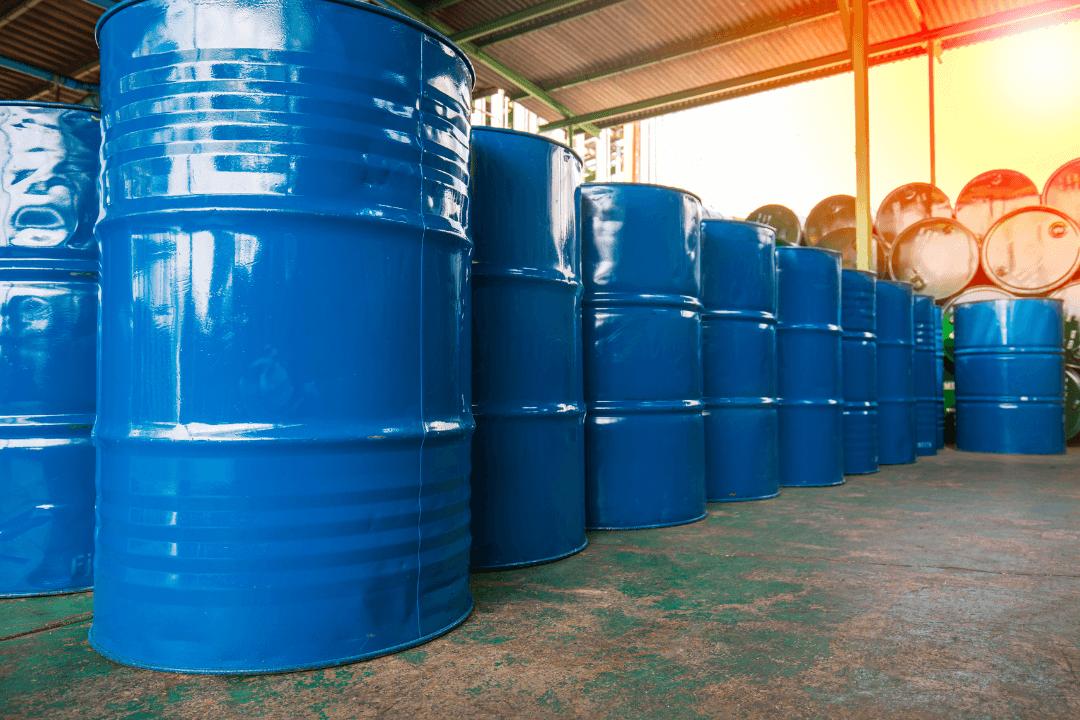
Image: steel drums stored in an industrial warehouse. Source: C.L. Smith
Lock in a Litsea Cubeba Oil Supply Agreement
The fastest way to evaluate a litsea cubeba oil supplier is a small sample order with the assay attached. Specify the citral content you need, usually 67 or 75 percent for commodity use and higher for fine fragrance, confirm the steam-distillation method, and check the batch GC-MS before scaling. Once quality is proven, a volume contract locks in price, grade consistency and delivery timing across the May-to-September harvest window, when fresh fruit prices are most favorable. Whether you need a 1 kilogram sample bottle or a full container of 180 kilogram drums, spicesmfr is ready to quote with full documentation and flexible MOQs. Request a quote today and build a citral supply line that keeps its bright, lemon-fresh character all year round.
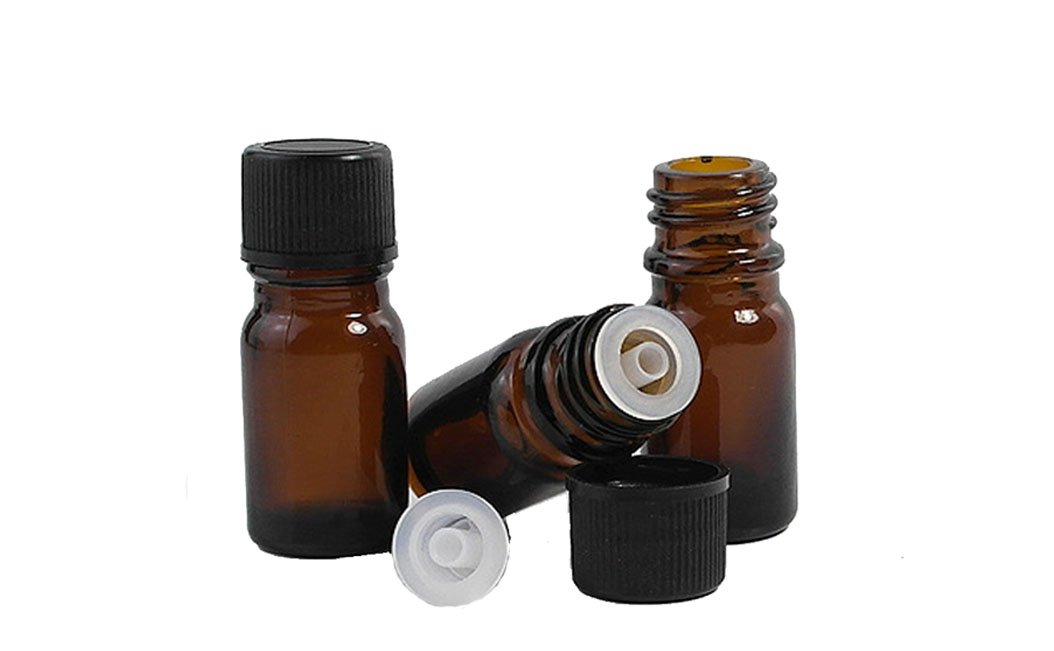
Image: amber glass sample vials for essential oil evaluation. Source: applianceselloff.com
Leave a Comment