

A Dried Peel With A Three Year Clock On It
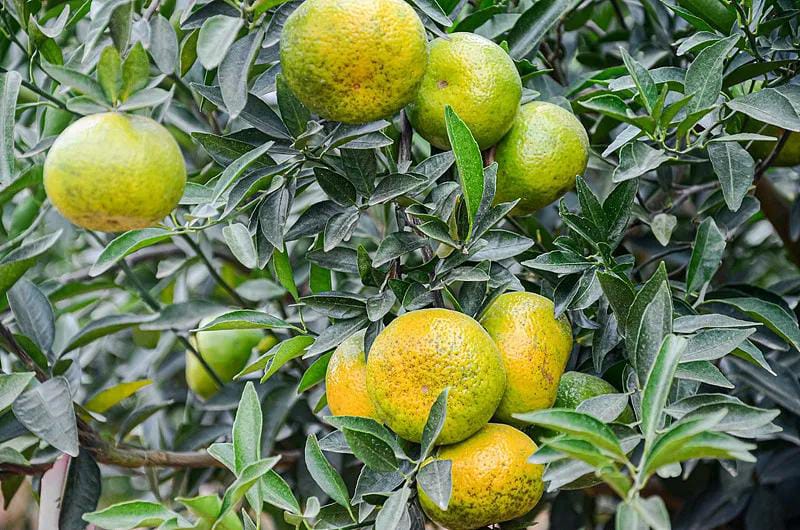
Fresh tangerine peel is a by-product. Chenpi is a manufactured ingredient, and the manufacturing step is time. The fruit is Citrus reticulata cultivar Chachi, grown mainly around Xinhui in Jiangdong, Guangdong. The peel is cut, sun-dried, then stored and turned for at least three years before it is allowed to carry the name. Until that clock runs out it is just dried peel, and it prices like dried peel.
That single rule explains most of what confuses first-time buyers. Two lots can look identical on a pallet and differ by a factor of five in price, because one is a 2019 lot and one is a 2024 lot. It also explains why the category has almost no industrial-scale supply outside China: nobody can shortcut the ageing step without the result tasting flat and dusty, and the buyers who care about this category can taste the difference.
The trade runs on three axes, and every quotation should be read against all three: cut format (whole three-petal piece, torn piece, shred), colour class (green peel, half-red, fully red), and vintage. A supplier who quotes a single price for "chenpi" is either selling one narrow specification or has not understood the question.
What Three Years Does To The Smell
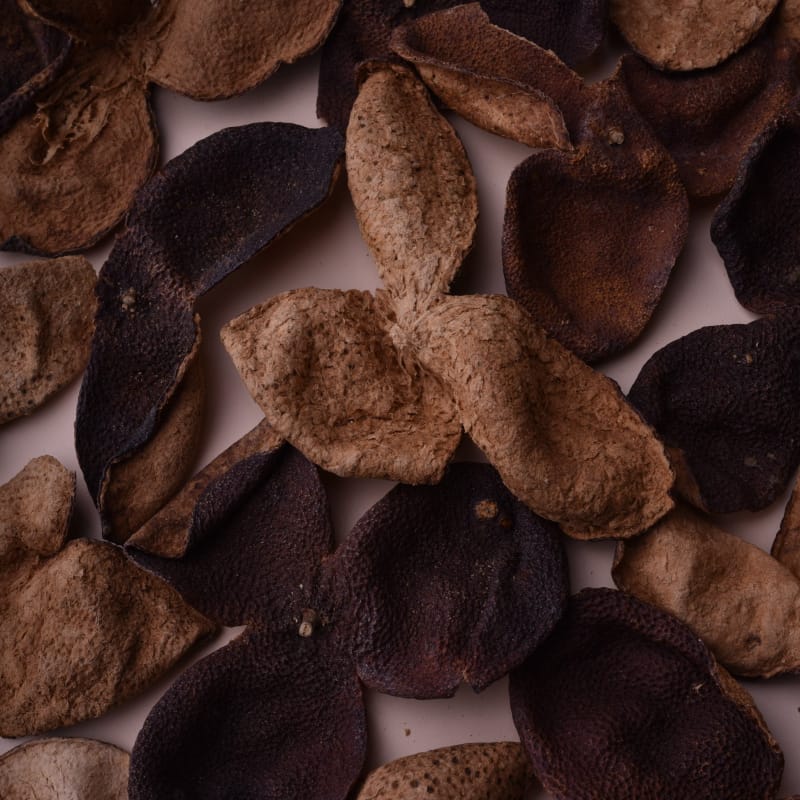
Open a bag of fresh-dried peel and the first thing you get is solvent. Sharp, almost acetone, the limonene and gamma-terpinene still sitting on top of the oil cells with nothing to hold them. It smells like peeling an orange next to a can of paint thinner, and it makes people step back.
Open a ten-year bag and the same compounds are still there, but they have gone quiet. What comes up is a low, sweet, almost medicinal woodiness, closer to old cigar box than to fruit, with a faint burnt-sugar edge underneath. Put your nose right into the bag and there is a dusty, dry note at the end, like the inside of a hay barn in August. That shift is not aromatherapy language. It is the volatiles oxidising and the flavonoids settling, and it is measurable in the lab as a change in the ratio of the monoterpenes.
So why do chefs pay four times more for an older piece? Because the aroma has moved from the front of the mouth to the back. Young peel announces itself in the first ten seconds of cooking and then vanishes. Old peel stays in the pot, sits under the fat, and turns up again in the aftertaste — which is exactly the behaviour a braise or a broth needs.
One District Supplies Most Of The Category
Chenpi is a geographic indication product, and the geography is unusually tight. Xinhui district in Jiangmen produces the bulk of what the market accepts as chenpi, and its industry figures are published by the district government and by provincial press. The numbers below come from three documents published inside ten months, and they do not agree on planted area — which is worth knowing before you quote a supplier's "official" figure back at them.
| Indicator | Figure | Source and date |
|---|---|---|
| Planted area | 147,500 mu | Xinhui district government, Feb 2026 |
| Planted area | 150,000 mu | Xinhui district government, Jul 2026 |
| Planted area | 168,000 mu | Yangcheng Evening News, Nov 2026 |
| Whole chain output value | RMB 28.3 bn | Xinhui district government, 2026 |
| Fresh fruit harvested | 280,000 t | Yangcheng Evening News, Nov 2026 |
| Peel output after processing | 14,000 t | Yangcheng Evening News, Nov 2026 |
| Registered operators | 7,808 | Yangcheng Evening News, Nov 2026 |
Sources at the end of this page. The area figures differ because of measurement timing and whether newly planted orchards are counted; treat 147,500 to 168,000 mu as the credible band rather than picking one number.
The ratio that matters commercially is in the middle of the table: 280,000 tonnes of fresh fruit becomes roughly 14,000 tonnes of finished peel. A 20:1 reduction sounds generous until you remember that the peel then loses more weight across three years of storage and turning. Buyers who model their cost on fresh-fruit weight are usually 10 to 15 percent optimistic by the time the lot is three years old.
Three Cuts Decide The Grade
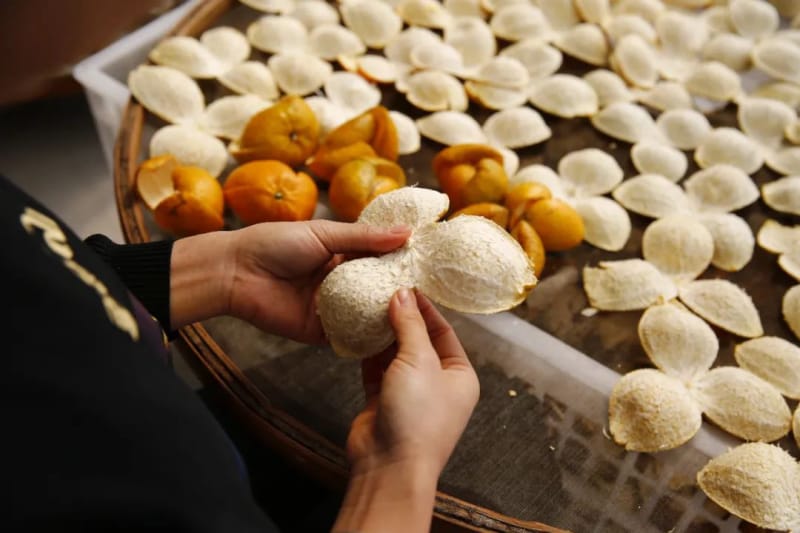
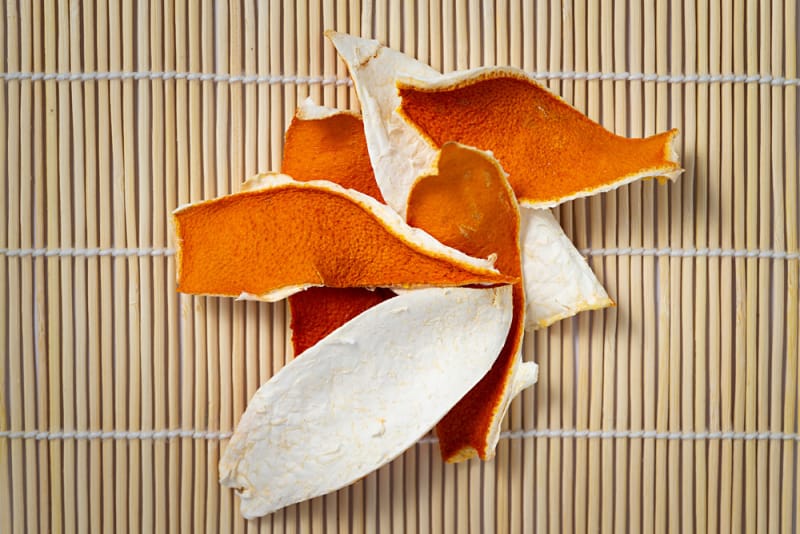
The traditional cut is three strokes from the top down to the stem, leaving the base intact so the peel opens into three connected petals. It is slower than machine peeling and it is the only way to keep the oil cells on the outer skin unbroken, which is where the aroma lives. A torn or quartered peel dries faster and sells cheaper, and the difference is visible across a table.
Harvest timing then sets the colour class, and the colour class sets the specification. Green peel picked before the fruit ripens carries the highest flavonoid load and the least sugar; fully red peel picked near winter solstice is sweeter, thinner in aroma, and cheaper per kilo of active compound. The Guangdong provincial standard for geographic indication chenpi writes the minimums into the grade itself.
| Class | Hesperidin | Nobiletin | Picking window |
|---|---|---|---|
| Green peel | ≥ 2.5 % | ≥ 0.25 % | August to September |
| Half red peel | ≥ 2.0 % | ≥ 0.20 % | October to early November |
| Fully red peel | ≥ 1.5 % | ≥ 0.15 % | Late November to December |
Values on a dried basis, from the geographical indication product standard for Xinhui chenpi (DB4407/T 70—2021). The standard sets floors, not typical values; well-made red peel regularly tests above its floor.
Practically, this is the first place a purchase order goes wrong. A buyer writes "chenpi, hesperidin 2.0 percent" and a supplier ships fully red peel, which is allowed to sit at 1.5 percent. The certificate is honest, the goods are compliant, and the buyer's own product specification is missed. Name the class, not just the number.
Five Numbers On A Certificate Of Analysis
A chenpi certificate is short. In export trade it usually carries five figures: hesperidin, nobiletin plus tangeretin, moisture, total ash, and a mycotoxin screen. The first two are the ones that decide whether the goods are legally chenpi at all.
The Guangdong provincial standard for Xinhui chenpi sets hesperidin at 2.0 percent or above, with the combined nobiletin and tangeretin at 0.40 percent or above; the shredded form is tested on the same basis. A second document, the Greater Bay Area Chinese medicine standard DWQZB20240001 for broad chenpi, takes a different route and requires hesperidin plus narirutin to reach 2.9 percent combined. Both are current and both are legitimate. They simply measure different things.
Which one a buyer cites should follow the destination market, not the supplier's convenience. A European food-ingredient buyer will normally write a specification against hesperidin alone and treat the polymethoxyflavones as a nice-to-have. A Hong Kong or mainland health-product buyer is more likely to want the combined figure. Ask for the raw chromatogram, not the summary line — a lot that passes at 2.05 percent is a very different commercial object from one at 3.1 percent, and the certificate looks identical on both.
Moisture Is Where Most Claims Fail
Flavour can be argued about. Water content cannot. Peel held above roughly 13 percent moisture will move within a few weeks of a sea freight: the pith darkens, the smell turns musty, and by the time the container is opened the lot has a mould problem that no re-drying will fully repair. Most contracts we see set a ceiling between 11 and 13 percent, and the sensible ones also set a floor, because peel dried down to 7 percent shatters in the bag and turns half the shipment into powder.
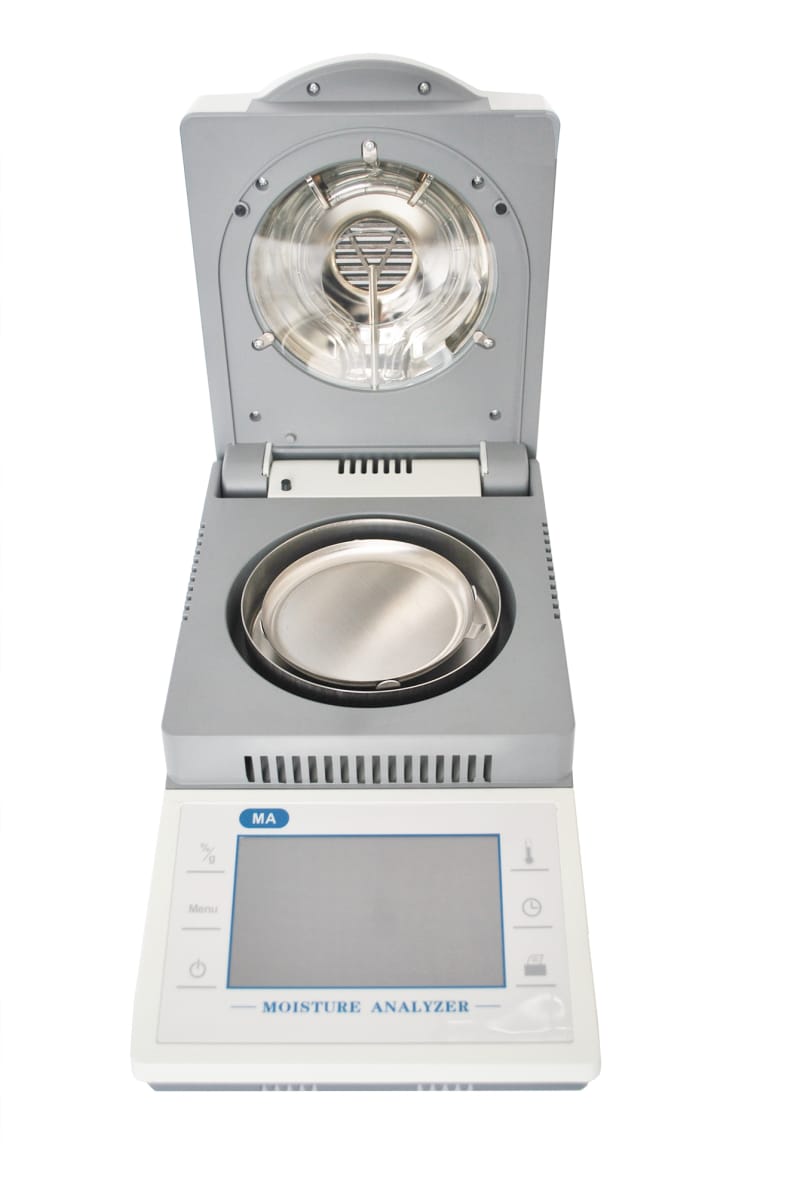
The test itself is unglamorous. A halogen moisture analyser takes 3 to 5 grams of ground peel, heats to about 105 degrees, and weighs until the reading stops falling; the whole run takes a few minutes per sample and belongs on the packing line, not in a distant lab. A lot that reads 12.4 percent on the line can read 13.6 percent at the port after two weeks in a humid yard, so the number on the certificate should carry a date and a sampling method.
Storage does more damage than transport. Dry, ventilated rooms with daily air movement keep peel stable for years; a sealed plastic-lined room in a wet Guangdong summer does the opposite, and the failure is silent until the bag is opened. If a supplier cannot tell you which building their stock sat in and for how long, the moisture figure is the least of your problems.
Who Buys This By The Tonne
There are two different markets inside the same bag. The first wants the flavour: seasoning houses, sauce and braise manufacturers, tea blenders, and restaurant groups running a fixed recipe across dozens of sites. They buy whole three-petal peel or shred, they care about vintage, and they will reject a lot on smell alone.
The second wants the molecule. Extractors and supplement formulators buy peel, shred or off-grade material and pay for hesperidin and polymethoxyflavone content, not for bouquet. That market is growing faster than the culinary one, and the published forecasts are worth reading with care because the definitions differ sharply between research houses.
| Scope as defined by the publisher | Base year | Forecast | CAGR |
|---|---|---|---|
| Pericarpium citri reticulatae extract | USD 535.4 m (2025) | USD 797.1 m (2032) | 5.9 % |
| Tangerine peel extracts | USD 236.7 m (2025) | USD 387.9 m (2032) | 7.3 % |
| Citrus peel extract, all citrus | USD 3.60 bn (2025) | USD 5.98 bn (2034) | 5.8 % |
Figures as published by PW Consulting, 24 Chemical Research and Dataintelo respectively. The three lines are not comparable: one counts a single botanical extract, one counts tangerine peel only, the third counts every citrus peel extract including orange and lemon. Use them for direction, never for a volume calculation.
Yulin Is Where The Lots Get Sorted
Chenpi grows in Guangdong and, for export, very often ships out of Guangxi. Yulin Fuda International Spice Logistics Port handles more than 160 spice categories across roughly 1,900 trading stalls, and its 2025 turnover reached RMB 33.5 billion, the third consecutive year above RMB 30 billion. Industry and municipal reporting puts about 80 percent of China's domestically traded spice volume and more than two thirds of the globally traded volume through this one market.
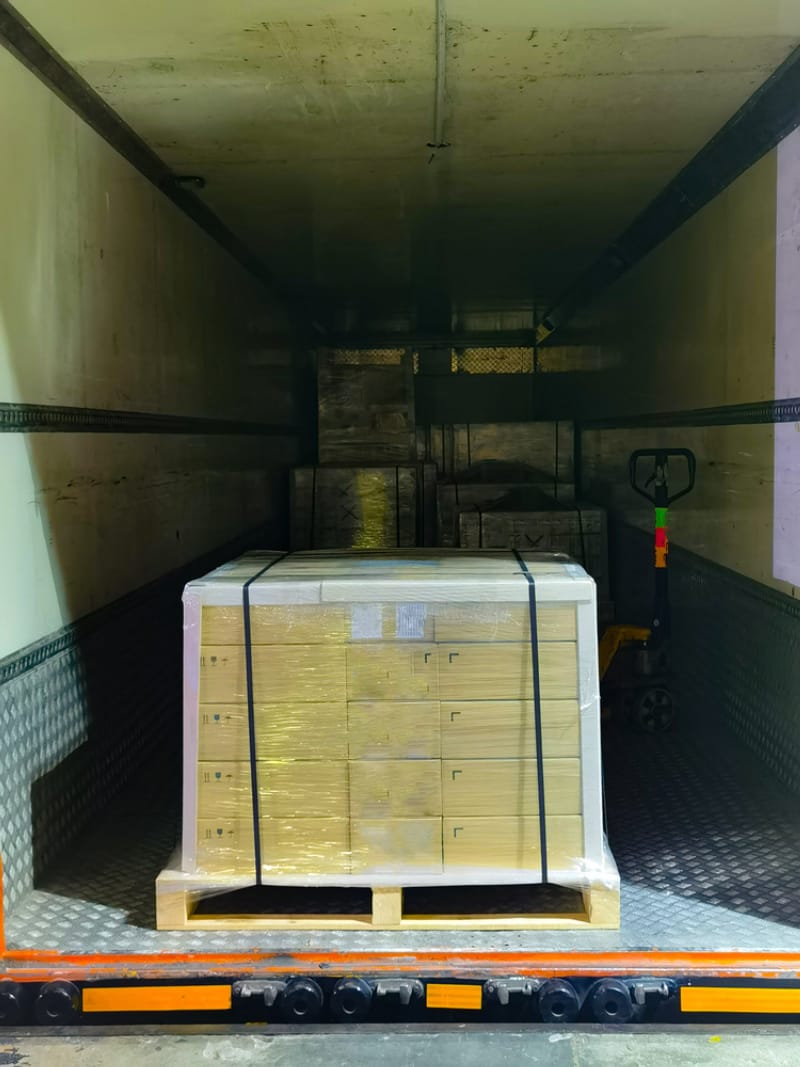
Why would a Guangdong peel travel to Guangxi before going abroad? Because consolidation is the product. A single container for a European seasoning plant rarely holds one spice; it holds peel, star anise, cassia and pepper, drawn from different provinces, inspected against one purchase order, packed to one pallet spec. Yulin is where those lots meet, get re-graded, get a uniform moisture reading, and leave under one set of documents.
| Indicator | Figure | Note |
|---|---|---|
| Spice categories traded | 160+ | Single-site wholesale market |
| Trading stalls | 1,900+ | Occupancy above 95 percent |
| 2025 turnover | RMB 33.5 bn | Third year above RMB 30 bn |
| Daily throughput | Over 1,000 t | Peak season average |
| Share of China trade | ~80 % | Reported by municipal and state media |
| Share of global trade | > 2/3 | Volumes passing through the port |
Compiled from Yulin municipal commerce reporting and state media coverage, 2026. The share figures describe spice volumes routed through the market, not China's total production.
In The Kitchen And In The Factory
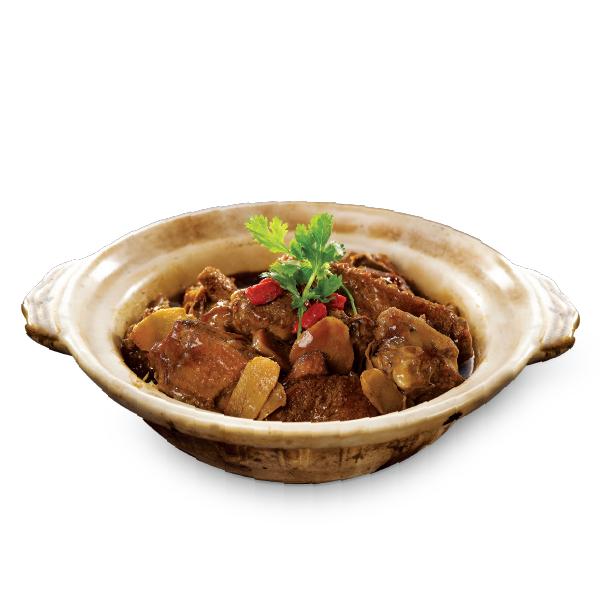
A braise is where most people meet chenpi without knowing it. Drop two or three pieces into a clay pot with pork belly, soy, rock sugar and star anise, and the first thing that changes is not the aroma but the finish: the sauce gets rounder, the fat stops tasting heavy, and there is a faint citrus-bitter echo at the back of the throat two seconds after you swallow. That echo is the point. Without the peel the dish is sweet and salty; with it, the dish has a bottom.
At factory scale the same logic is expressed in kilos and in process order. In a soy-sauce base, peel goes in early and stays through the whole cook, because the flavonoids need time and heat to release. In a bouillon or a snack seasoning, peel is added late or as a fine powder, because the volatile fraction is what carries the top note and it will boil off in twenty minutes. Getting the order wrong produces a product that tested well in the pilot kettle and tastes hollow six weeks later on the shelf.
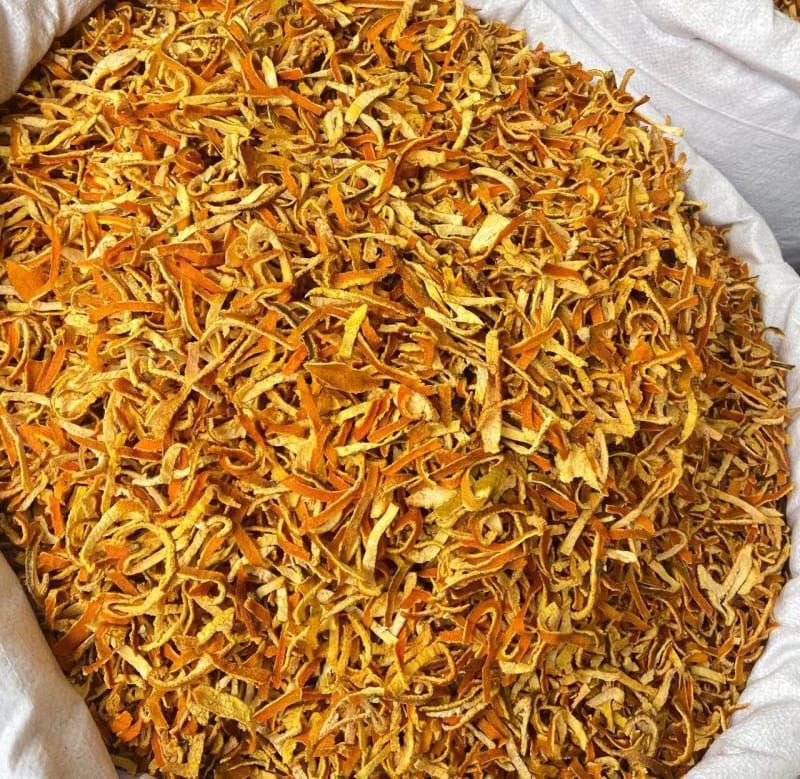
The one place the two markets meet is shredded peel. It infuses faster than whole pieces, it doses evenly by weight, and it is the format most sauce plants standardise on. The trade-off is that shred loses aroma roughly twice as fast in storage, so a shred buyer should be buying smaller lots more often, not a year's tonnage at once.
What Buyers Get Wrong About Age
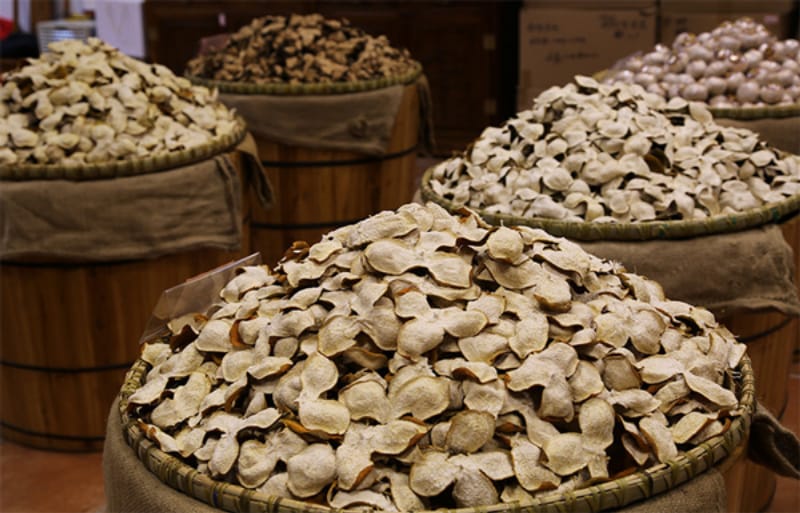
The most common mistake is reading darkness as age. A dark brown piece is often a badly stored piece: high humidity, poor air movement, and the pigment oxidising faster than the aroma develops. Genuine ten-year peel can be deep brown, but it can also be a warm reddish brown with visible oil cells still intact. Colour alone tells you almost nothing.
The second mistake is trusting a printed vintage. There is no paper trail requirement on a wholesale lot, and the price gap between a three-year and a fifteen-year piece is wide enough to fund a false label. What a buyer can actually verify is narrower and more useful: the storage building, the turning records if the supplier keeps them, the moisture history, and whether the smell matches the claimed age when the bag is opened in front of you.
My own view, after a few years of watching this category, is that the vintage premium is real but badly distributed. The jump from three to eight years changes a dish noticeably. The jump from fifteen to twenty-five mostly changes the invoice. Buyers who need the flavour should be paying for eight to twelve years and putting their diligence into moisture and storage instead; the collectors' end of the market is a different business with different rules.
What To Write In The Purchase Order
Most disputes in this category are not quality failures. They are specification failures, written into a document that was too loose to enforce. Six lines fix most of them, and none of them cost anything to add.
| Line | What to write | Why it matters |
|---|---|---|
| Class | Green, half red or fully red peel | Each class has a different legal minimum |
| Cut format | Whole three-petal, torn, or shred, with a size band | Shred infuses faster and stores shorter |
| Vintage | Ageing period stated in years, with a packing date | Price and aroma both depend on it |
| Moisture | A ceiling and a floor, tested on the line | Too wet moulds, too dry shatters |
| Analysis | Hesperidin and polymethoxyflavone floors, method named | Two valid standards measure differently |
| Residue and toxin screen | Pesticide list, heavy metals, mycotoxins | Destinations differ, assumptions do not survive |
Drafted from standard commercial practice in this category. The reference methods and limits should be matched to the importing country's own rules before the order is placed.
Two clauses that are worth adding on top: a sample retention clause, so both parties hold the same 500 grams for twelve months, and a photograph clause, so the goods are photographed on the pallet before the container is sealed. Neither is exotic. Both end arguments that would otherwise run for weeks over a difference nobody can prove.
A Closing View On This Material
Chenpi is one of the few spice materials where the supply chain is genuinely short. One district, one cultivar, one three-year waiting period, and a lab test that can be read on a single page. That is unusual, and it is an advantage for buyers who treat it as an ingredient rather than a commodity.
The district's own figures support the same reading: 283 billion yuan of whole-chain value in 2025, more than 7,800 registered operators, and a processing yield that turns 280,000 tonnes of fruit into about 14,000 tonnes of peel. Volume is not the constraint. Consistency is. A buyer who locks a class, a cut, a vintage band and a moisture range gets a repeatable material; a buyer who asks for "good quality chenpi" gets whatever was on the floor that week.
If you are specifying this material for a sauce line, a tea blend or an extract, the conversation is usually shorter than people expect. Send the class, the format, the annual tonnage and the destination market, and the rest is arithmetic and a lab report.
Specification requests and volume quotes
Whole three-petal peel, torn piece and shred, green to fully red, three to twelve year bands, consolidated for export through Yulin Fuda.
Leave a Comment